Treatments
What gets treated here, and how long a course really takes.
Pain is the common thread. For each of the main reasons people come, here is the honest version: how many sessions, what should have changed by when, and the point at which stopping is the right call.
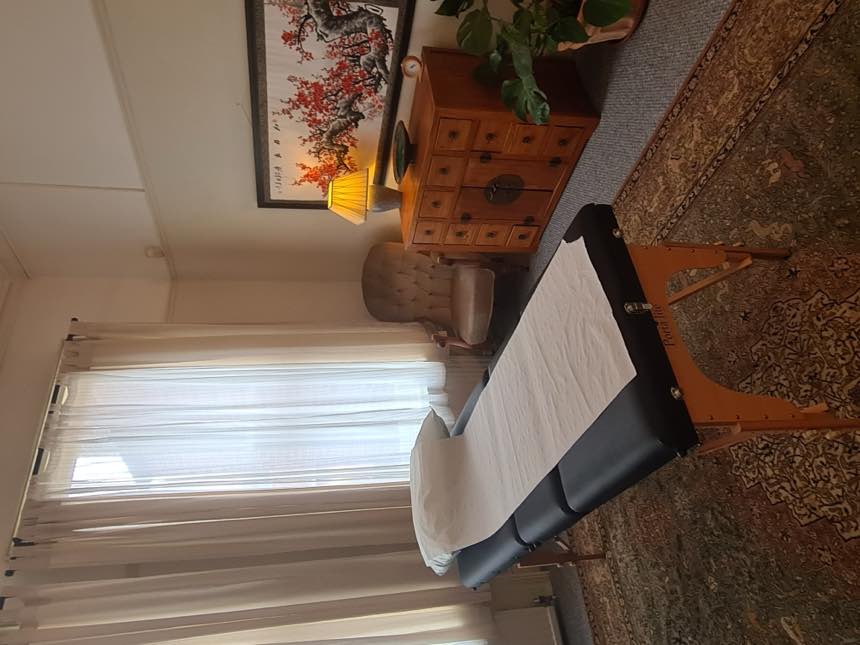
The treatment couch at The Practice Rooms, Wilkinson Street.
The approach
This is Western medical acupuncture.
Worth knowing before you book, because the two versions of acupuncture on offer in this country are not the same thing.
Acupuncture came out of China, where it sits inside Traditional Chinese Medicine. Western medical acupuncture keeps the needles and leaves the rest behind. It is practised by registered healthcare professionals working from anatomy, physiology and pathology, and it is held to the same evidence standards as anything else offered in a clinic.
So nothing here gets explained in terms of energy, meridians or blocked channels. The working explanation is a physiological one. Needling appears to switch on the body's own pain damping systems, and a considerable body of Western pain research has gone into understanding how.
None of that makes it a cure, and it does not put acupuncture beyond question. It does mean the reasoning behind your treatment will be reasoning you can follow.
Condition
What treatment looks like
Typical course
Chronic pain
Pain lasting longer than three months
Pain that has outlasted whatever started it, or never had a clear cause to begin with. Treatment aims at the intensity and the interference, not at the original injury, and progress is measured against what you can actually do rather than a number out of ten alone.
6 to 8 sessions
Weekly at first. Review at session four.
Persistent musculoskeletal pain
Back, neck, shoulder, knee, hip, sports and overuse injury
Needling into the muscles around the painful area and at points further away. Movement and loading advice goes with it, because the treatment holds better when the area is being used rather than protected.
6 to 8 sessions
Weekly at first. Review at session four.
Neuropathic pain
Burning, shooting or electric shock pain
Needles are carefully placed in and around the area being treated. Needling can stimulate and release the body's endorphins and neurotransmitters, which can help with neuropathic pain.
6 to 10 sessions
Weekly, then spaced out as it settles.
Trigeminal neuralgia
Facial nerve pain
Treated cautiously and always alongside whatever your neurologist or GP has prescribed. Acupuncture is not a reason to reduce or stop medication, and any change to that is a conversation with the person who prescribed it.
6 to 10 sessions
Weekly, with a careful review at four.
Pain caused by fibromyalgia
Widespread pain and tenderness
Sessions are deliberately gentle and use fewer needles, because the pain threshold is usually low and a heavy treatment can set you back. The aim is a lower overall pain load and better sleep rather than the removal of symptoms.
6 to 10 sessions
Weekly, then spaced out.
Pain caused by FND
Functional neurological disorder
The pain is treated as pain, alongside the neurology, physiotherapy and psychology already involved. Nothing here suggests the pain is imagined, and nothing here claims to treat the underlying disorder.
6 to 8 sessions
Weekly, reviewed closely as you go.
ME
Myalgic encephalomyelitis
Short, conservative sessions that fit around pacing rather than cutting across it. Overdoing treatment costs more than it gains here, so the sessions stay small and the gaps stay generous.
4 to 6 sessions
Spaced, and led by how you respond.
Migraine and tension headache
Prevention, not rescue treatment
A preventive course spread over several weeks, aimed at reducing how many headache days you get in a month rather than shortening an attack you are already in. You keep a simple diary so we are comparing numbers and not impressions.
8 to 10 sessions
Across 6 to 8 weeks, then reassess.
Then top up treatments, every 6 to 8 weeks
Once a course has done its work, most people need a single session every 6 to 8 weeks to stop the pain creeping back. That is the long term shape of this: not endless weekly appointments, and not a one off cure either.
The needles
The part everyone is quietly worried about.
They are far finer than you think
Between 0.16 and 0.30 mm across, roughly the width of a hair. Around forty of them would fit inside the needle used to take your blood.
Sterile, single use, opened in front of you
Sealed until the moment they are used, and straight into a sharps bin afterwards. Nothing is ever reused, on anyone, including you.
Four to twelve, in for twenty minutes
That is a typical session. You lie still, usually warm, often half asleep. A fair number of people nod off entirely.
What can happen afterwards
A small bruise, or a heavy or drowsy hour. Many report a great night's sleep following treatment. Serious problems are rare, and you get told what to watch for before you leave.
Safety
Tell me about these before you book.
None of them automatically rules acupuncture out. They change how it is done and which points are used. Leaving them out is the only thing that causes a problem.
- 01Anticoagulants, or any bleeding or clotting disorder
- 02A pacemaker or any implanted electrical device
- 03Allergies of any kind
- 04Pregnancy. It does not rule acupuncture out, but tell Daisy before arranging the appointment
- 05Lymphoedema, or a limb at risk after node clearance
- 06Epilepsy, or a history of fainting with needles
- 07A weakened immune system, or current infection
- 08Broken skin, a rash or a wound over the area to be treated
Questions
The ones that come up every week.
Does it hurt?
Mostly no. You feel a tap going in, and sometimes a dull, heavy ache around the needle for a second or two, which is normal and usually settles. Sharp pain is not normal, and if you feel it, say so and the needle comes out.
What should I wear?
Loose, comfortable clothing that moves out of the way easily. Most treatment is on the lower legs, forearms, back or shoulders, so you keep most of your clothes on and you are covered throughout.
Can I drive home afterwards?
Yes. Some people feel heavy or drowsy for an hour or so afterwards, so if that is you, sit in the waiting area until it passes rather than getting straight into the car.
Do I need a referral from my GP?
No, you can book directly. It is still worth telling your GP you are having acupuncture, particularly if you take medication for pain.
Will my health cash plan cover it?
Some plans reimburse acupuncture and some do not, so check with yours before you book. An invoice is provided for every appointment for you to claim against.
What happens if it does not work?
You stop. Progress is reviewed at session four, and if nothing has shifted by then Daisy will say so and you keep your money rather than booking a fifth. Where something else is more likely to help, she will tell you what.
Further reading
Go and check the evidence yourself.
None of this is written by me, and none of it is trying to sell you an appointment. If you would rather form your own view before booking, start here.
Paper, PDF
Western medical acupuncture: a definition
Adrian White's short paper setting out a formal definition of the Western medical approach, and drawing the line between it and traditional Chinese practice. The clearest single statement of what this treatment is.
Review, PDF
A Reappraisal of Acupuncture
A longer look by the same author at the evidence and the proposed mechanisms. Written for clinicians rather than patients, so read it if you want the argument and not just the conclusion.
Evidence summary
Evidence for Acupuncture
Mike Cummings, Medical Director of the British Medical Acupuncture Society, on what the trials and reviews actually show. The place to start if you want the evidence base rather than anyone's word for it.
Video talk
The neurophysiology behind acupuncture
Thomas Lundeberg on what is thought to happen in the nervous system when a needle goes in, recorded at the BMAS Physiology Day in December 2013. Watching rather than reading.
Condition summary
Acupuncture in low back pain
The BMAS summary of evidence and guidance for low back pain specifically, which is the single most common reason people walk into a clinic like this one.
NHS guidance
NICE NG193: rationale and impact
The committee's own reasoning behind the chronic primary pain recommendations, including where acupuncture sits within them. This is the guidance the NHS works to, with the thinking left in.
NHS service
Acupuncture for chronic pain and headache, UCLH
University College London Hospitals describing the acupuncture service it runs for chronic pain and headache. Useful context if you are weighing up whether this sits inside mainstream care or outside it.
All external links, opening on the publisher's own site. Nothing here is written or endorsed by this practice. Links last checked September 2026.
Not sure whether yours is on the list?
Send a short message describing the problem. You will get an honest answer, including the answer that says this is not the right treatment for it.